
Hello.
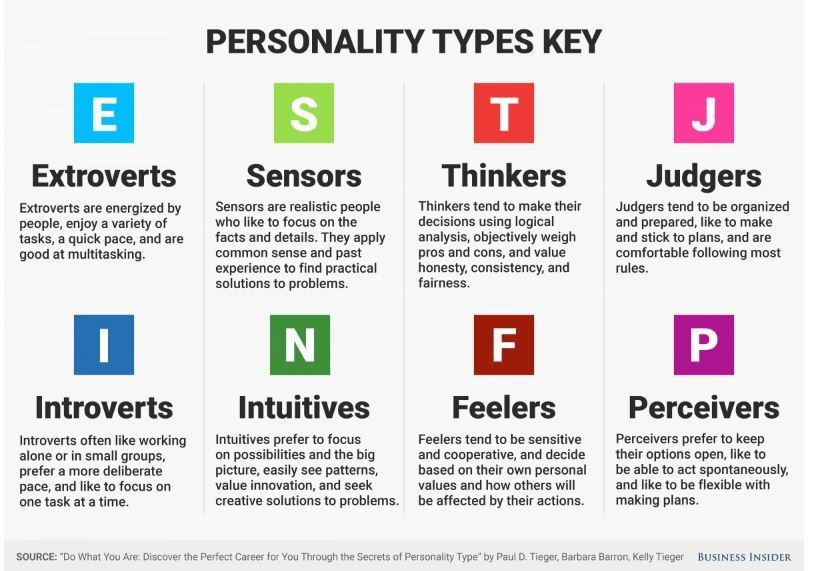
During my psychology class last week I watched a video detailing the shortcomings of the Myers-Briggs, or as you might know it, the “MBTI Test”. You’ve probably heard of personality types from it before – four letter combinations meant to place you into one of sixteen distinct personality types.
But does personality really work that way? The MBTI test was inspired by the Carl Jung’s idea of humans being split into perceivers and judgers. Each of these two groups were also split into two, creating four main groups of personality types. Katherine Briggs and Isabel Myers, who previously had notably no training in psychology, theorized the MBTI test by adapting Jung’s personality types and making it so that people would be placed into one of two types in each category based on questions.
BLACK AND WHITE
The problem is obvious: We aren’t completely assigned to either category. Take thinkers and perceivers. The MBTI tells you that you’re either one or the other. Even someone leaning heavily towards one side may have a part of them that agrees with the other. Something like this isn’t represented in the MBTI whatsoever – you’re either all into one thing or not. It hasn’t been shown to be reliable, either. Studies show that 50% of test takers got a different result when retaking the test after a few weeks.
The uncredible nature of the test is more important than you’d think. Over 2 million people take it every year and the company that runs it makes 20 million dollars off of it. Beyond that, multiple jobs use the test as an indicator to see what kind of people applicants are. Human’s aren’t black and white in personality – they adapt based on their surroundings and situations. Rigid labels like these aren’t accurate and using them in important scenarios like job interviews is detrimental to both applicants and employers. Have you ever heard of the term “pigeonholing” before? It’s essentially what using the MBTI in a work environment can do – assign people to a category that is too rigid or exclusive.
To a personal extent, the MBTI can cause us to overidentify with a specific category that might not completely represent our own values. There’s a sort of desire to that point, one that I’ll go further into later. To generalize it, we naturally enjoy being put into groups because it helps us believe we understand ourselves and others better, and find it easier to associate with others that we believe have the same values that we do. There’s an article from the Atlantic that I thought went over this quite nicely. I’ll link it right below this.
https://www.theatlantic.com/health/archive/2015/09/people-love-the-myers-briggs-personality-test/404737/

Self-fulfilling prophecies
While we may WANT to understand ourselves better by finding a category that claims to describe who we are, there’s also distinctly negative results stemming directly from this. We know by now that the MBTI is incorrect in placing us in a single category. So what happens when we are assigned a type and begin to naturally conform into that type instead of exploring diverse options that may appeal to our smaller, less obvious traits that the MBTI doesn’t recognize.
Individuals tend to overidentify with their type as well. After a while of believing that you’re one thing, you might find it hard to believe that it’s even possible to become another. MBTI results can directly get in the way of personal growth or change. Worse yet, you could use it to justify decisions because they fall into your category.
“The danger of the MBTI lies not in what it reveals, but in what it obscures about human potential.” — Dr. Robert McCrae, Personality Theorist
The fact is that there are better ways to judge personality. The Big Five personality traits, for example, are empirically and supported and more dynamic, with it being possible to possess parts of all five. If you don’t know what they are, the acronym “OCEAN” is often used to memorize these.
Openness, relating to creativity and insight.
Conscientiousness, relating to thoughtfulness and goal-directed behavior.
Extraversion, which is memorable as being similar to being extroverted.
Agreeable, having to do with trust and kindness.
Neuroticism, usually related to emotional instability.
You can take Big Five personality tests online. As usual, it’s not going to be 100% accurate, as it’s only based off multiple choice questions or polls. However, the way results are shared through the Big Five are considerably more reliable than the MBTI.
What for?
I’ve been trashing on the MBTI for this entire post, but that doesn’t mean it’s completely useless. Like I said before, we enjoy placing ourselves into groups with others that are similar. The MBTI is good at that, and it’s certainly entertaining to take the test and see what our results are. The MBTI is good for entertainment – but that’s all it really should be used for. If you really want a semi-accurate and reliable test of your personality, take a look at a Big Five test.
We shouldn’t use MBTI to judge whether we should be hired at a job or not. It shouldn’t be used to change the way we act to conform to it. And most importantly, don’t believe that because you’re told you’re of one personality type you cannot be another at all.
 ElysianState
Leave a comment